
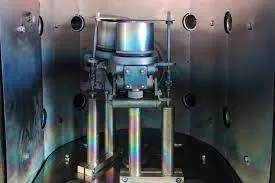
Thermal evaporation is a frequently used Physical Vapour Deposition (PVD) technique. This type of thin film deposition is a vacuum-based technique for coating diverse objects’ surfaces with pure materials. The coatings, also known as films, can be made of a single material or a combination of materials arranged in layers. Their typical thickness ranges from angstroms to microns.
The substances administered under vacuum Pure atomic elements, including metals and nonmetals, can be used in thermal evaporation processes, as can compounds like oxides and nitrides. The main objective is to coat the substrate, which can include a wide range of items such as semiconductor wafers, solar cells, optical components, and more.
The broad category of PVD includes numerous additional types of thin film deposition. Creating finished films can involve various techniques such as evaporation, sublimation, ion deposition, atomic laser deposition, laser ablation, and more. It could be helpful to briefly outline some fundamental concepts connected to these diverse processes. In this blog, let’s dive deeper into thermal evaporation.
What is Thermal Evaporation
Physical vapour deposition, often known as PVD, frequently uses thermal evaporation. One of the most basic types of PVD, it usually involves using a resistive heat source to evaporate a solid substance in a vacuum to create a thin film. A high vacuum chamber is used to heat the material until vapour pressure is created. The substrate is coated while the evaporated material, or vapour stream, moves thermally through the vacuum chamber.
Three Primary Thermal Evaporation Methods
Resistive Thermal Evaporation Deposition
One technique, frequently called resistive evaporation deposition, evaporates the coating material using a straightforward electrical resistive heating source or filament. These resistive evaporation filaments come in various physical shapes, including “boats”—thin sheets of suitable high-temperature metals (such as tungsten) with created indentations or troughs into which the material is deposited. Low voltage provides safety with the resistive filament heating source, but an extremely high current—typically several hundred amps—is needed.
Compared to other PVD methods, Resistive Thermal Deposition can offer high deposition rates at a lower cost. It is a relatively easy PVD coating procedure with metals or nonmetals/dielectrics like chrome, aluminium, indium, gold, silver, calcium, lithium, and more. It has good directionality and can be utilised with materials with low melting points.
Film densities are one of the drawbacks of resistive thermal vapour deposition, albeit they can be increased using ion beam-aided deposition. It can be used for comparatively less money, but its scalability is constrained. It has higher levels of potential contamination than more complex PVD techniques.
Electron Beam Evaporation
Using an electron beam, often known as an E-Beam, as a heat source is another frequent practice. E-Beam systems always contain additional safety precautions because this is unquestionably a more “high tech” method of heating a material and includes some dangerously high voltage (often 10,000 volts). The source is an “E-Beam gun,” where a tiny, extremely hot filament boils out electrons that are then accelerated by the high voltage to generate an extremely energetic electron beam.
The material is waiting in the crucible, where this beam is magnetically focused. Even 0.1 amp of this beam current at the usual 10 kV will give 1 kilowatt of concentrated power, heating the material inside a water-cooled hearth to prevent self-destruction. These commercially available E-Beam guns frequently contain multiple crucibles, allowing them to hold various materials simultaneously and quickly switch between them for multi-layer processing.
E-Beam Evaporation has some benefits over Resistive Thermal Evaporation and Sputtering, including faster deposition rates. Compared to resistive thermal evaporation, it is preferable for materials with greater melting points. Excellent degrees of purity, excellent coating use efficiency, and good directionality are all produced by this process.
High melting point coating materials, including yttrium oxide, hafnium oxide, molybdenum, silicon, tantalum, tungsten, and others, work well with e-beam evaporation. It’s commonly used to manufacture solar panels, eyeglasses, architectural glass, and laser optics because it is suitable for high-volume batch production.
Flash Thermal Evaporation Deposition
A heated ceramic crucible or the heating element is used in flash thermal evaporation, which causes a tiny wire or coating material to almost instantly evaporate when power is applied or continuously fed into the hot element. While the diameter of a wire restricts deposition rates and thicknesses, employing crucibles speeds up Flash Thermal Evaporation. For constant film thickness, how coating particles are fed into the crucible is a critical success component.
Uses of Thermal Evaporation
Optics
It is common practice to cover optical and ophthalmic lenses using thermal evaporation. The evaporation of many layers improves the lenses’ characteristics. These include mirror coatings, hard coatings, infrared or ultraviolet light protection, sun protection, and anti-reflective layers.
Depending on their diameter, the vacuum chambers can contain up to several hundred lenses each, with diameters up to 1500 mm. Specially created rotatable calottes are used to attach lenses, ensuring consistent thin films on every product in a batch. Therefore, the vacuum system comprises a larger 2000/s class turbomolecular pump or a cryopump coupled with a small roots blower for the vacuum system.
Consumer Packaging
Larger coating equipment typically produces web coating for packaging foils. “Roll-to-roll” web coaters coat plastic foils with films such as aluminium. These thin layers shield consumer items from moisture and the elements, extending their freshness and shelf life.
The gas flow into the vacuum system is enormous in these production machines. The enormous foil surfaces that require coating produce massive volumes of degassing at several metres per second due to their high foil throughput. Large oil diffusion pumps are typically used in vacuum systems to pump air supported by cold panels to condense water vapour. Cryogenic freezers, also known as cryo chillers or “Polycold machines,” are used to cool these cold panels.
Takeaways
- Thermal evaporation is a useful technique for coating various surfaces with pure materials and creating thin films.
- Resistive thermal evaporation deposition is a simpler and cheaper process, but it can result in lower film densities and higher contamination levels.
- Electron beam evaporation is faster and more precise, making it ideal for producing high-volume products like solar panels and glass.
- Flash thermal evaporation is a popular method that rapidly evaporates tiny wires or coating materials.
- Thermal evaporation is used for coating lenses and packaging, but it requires specialised equipment and safety precautions, which makes it more expensive to set up and maintain.
